
Why B2B companies struggle to control partner sales - and what to do about it
By Simon Olesen
In many organisations, partner channels account for up to half of total revenue, yet the rigour applied to direct sales rarely follows. And here is the uncomfortable truth, this is not a priority problem. It is a structural one, and the longer it goes unaddressed, the more value quietly walks out the door.
The hidden complexity of partner channels
Partner sales have become a core part of how B2B companies grow. Partner channels provide access to new markets, new customer segments, and the ability to scale beyond what a direct salesforce can handle. But while partner sales are easy to start, they are difficult to manage well, and most companies underestimate what it takes.
At first, the model seems simple. A manufacturer sells to a partner. The partner sells to the customer. Orders flow through the channel. But as soon as partners are introduced, complexity increases, multiple layers of contracts, different pricing agreements across markets, rebates, fees, commissions, and indirect relationships through distributors and buying groups. What used to be a direct process becomes a web of transactions, agreements, and dependencies.
And with that complexity comes risk.
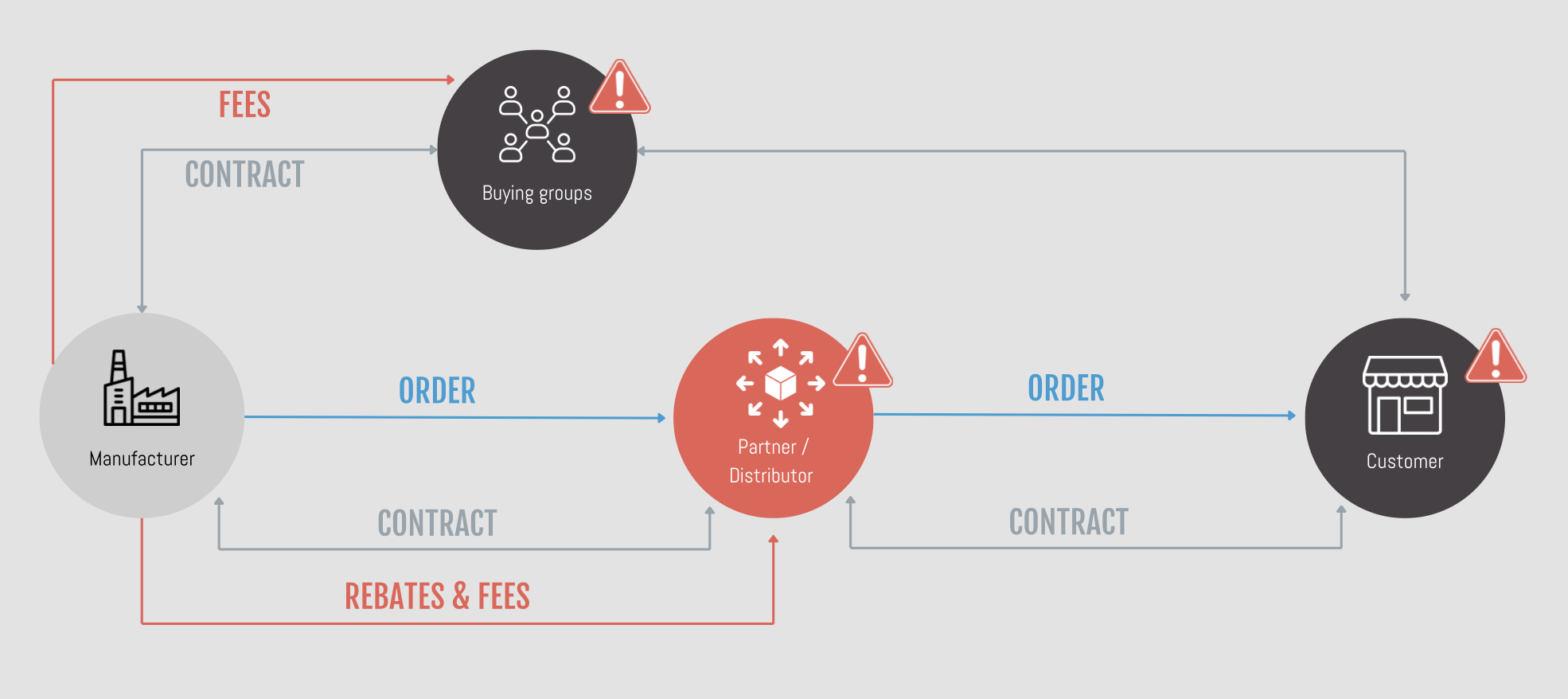
Where value leaks
When partner sales are not actively managed, the same three problems tend to surface, however, they are often overlooked because they are masked by revenue numbers that look healthy enough to avoid scrutiny.
Margin erosion: Without clear pricing guardrails (and the ability to enforce them) products get sold below intended price points. This will often happen gradually, and it will not be visible until it is already happening, and it starts shows up in the numbers.
Loss of market visibility: As partners take over the customer relationship, companies lose insight into who is buying, what they are buying, and why. CRM systems become incomplete or outdated and the commercial and strategic decisions that depend on that data become guesswork.
Incentive misalignment: Many partner models reward volume because it's simple to measure. But volume targets push partners toward whatever closes the deal fastest, which is often discounting, instead of what is the most profitable or strategically important. When the incentive is volume alone, partners optimise for their own success, not yours.
These issues are rarely visible at first. But they compound over time and create leakage across pricing and execution.
Why adding resources does not fix it
A common response we have seen across client projects is to add more resources, more people to manage contracts, more spreadsheets to track rebates, more manual controls to validate transactions. Yet many organisations already have large operational teams, multiple systems, and extensive reporting. And still struggle to get control.
The issue is not effort, it is structure. Without a clear operating model, more people only add complexity, and you end up with a larger team facing the exact same problems. Without the right systems in place, more data only adds confusion, and you are left with dashboards full of numbers that nobody knows how to act on.

“Partner channels account for up to half of revenue in many organisations, yet rarely receive the same commercial discipline as direct sales.”
Getting in control: the three elements
In our work with global B2B manufacturers, we have found that getting in control comes down to three elements working together:
Enablement: Partners prioritise manufactures that are easiest to work with. If product information, pricing, and quoting require manual effort, partners shift focus to manufactures that make it easy. Enablement means making it simple and fast to do the right thing.
Incentives: Incentives shape behaviour. If partners are rewarded for volume alone, they will push volume. If they are rewarded for selling the right products at the right price, behaviour changes. This requires moving beyond basic rebate structures and ensuring that incentives reflect the outcomes you want to achieve.
Transparency and control: Enablement and incentives only work if you can see what is happening and act on it in real time. This means having visibility into, transactions, prices, customers and contracts across both direct and indirect sales. Without this, you are operating on assumptions. With it, you can guide performance and intervene when needed.
The foundational capabilities
These three elements need a structured foundation beneath them. In practice, this comes down to five capabilities revolving around exactly enablement, incentives, and transparency & control. Translating these from theory into reality requires moving away from fragmented legacy tools and adopting systems tailored to the complexities of indirect sales.
There must be two-way transparency, partner enablement and aligned incentives to get control of partner sales
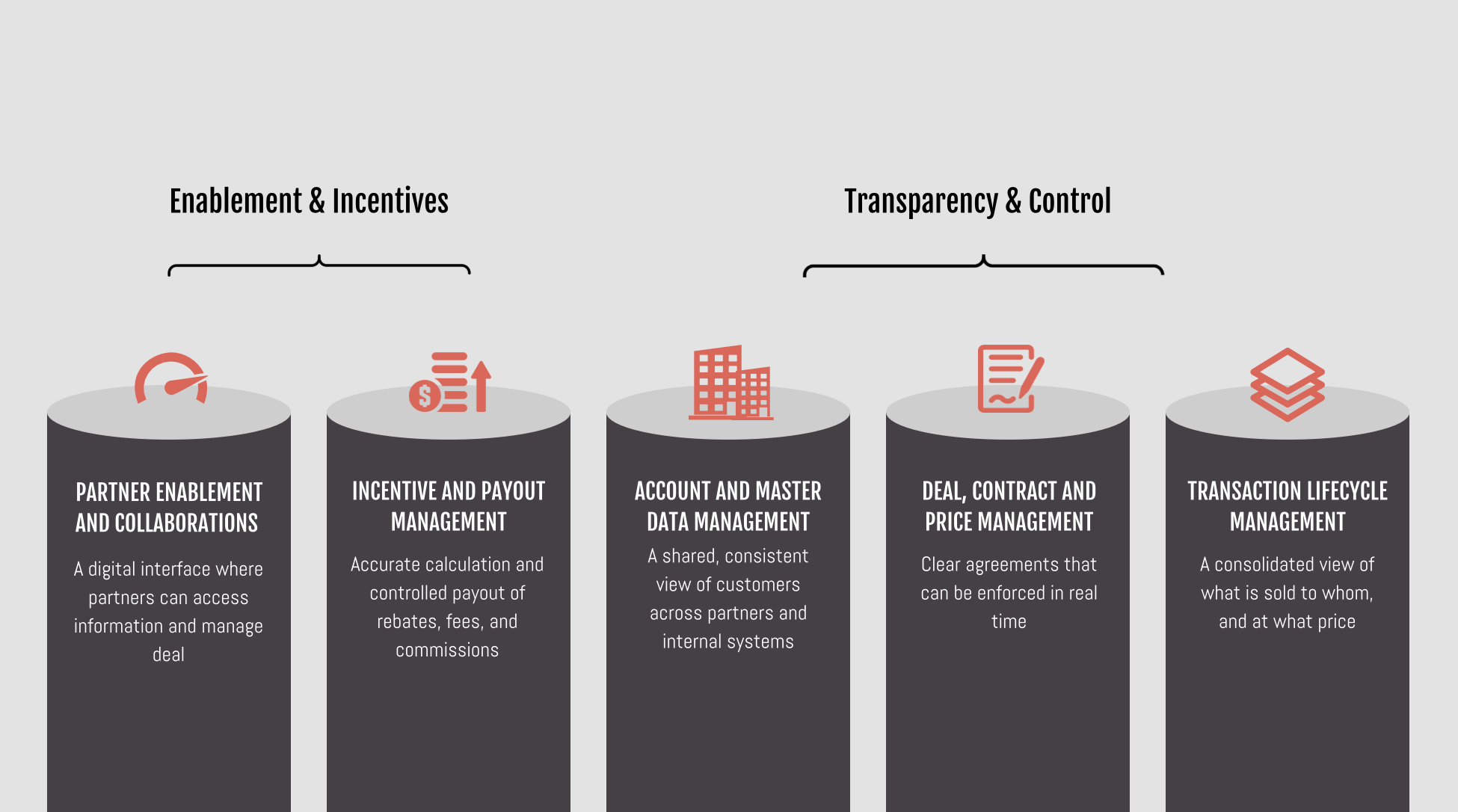
Partner enablement and collaboration: A digital interface where partners can access product information, pricing, and manage deals without picking up the phone. As previously mentioned, partners take the path of least resistance. If working with you requires a lot of effort, they will prioritise someone else. By deploying a robust Partner Relationship Management (PRM) portal, you create a frictionless, centralized hub. This doesn't just make it easy for them to quote and sell; it establishes a mutually beneficial platform that actively encourages them to share their pipeline data with you.
Incentive and payout management: When rebates, fees, and commissions are calculated manually on fragile spreadsheets, errors are difficult to avoid which can put partner trust at risk. Furthermore, manual processes often force companies into simple volume-based rewards. An automated Incentive Compensation Management (ICM) and Rebate Management system acts as the steering wheel for your channel. It guarantees accurate, dispute-free payouts while allowing you to effortlessly design and execute complex incentives that reward strategic behaviours, like selling premium product lines or sharing end-user data.
Account lifecycle and master data management: Operating without a shared view of customer data across your partner network effectively leaves you in a "black box". When distributors sell on your behalf, you lose critical visibility into who the end customer actually is, their industry, or their specific needs. By anchoring a shared master data model within a unified Customer Relationship Management (CRM) system, you eliminate these blind spots. Partner data flows seamlessly into your organisation, allowing you to identify exactly who is engaging with your brand as sales occur. This transforms fragmented channel activity into continuous, actionable market intelligence, empowering you to forecast accurately, understand your true market share, and leverage end-user insights for future product development.
Deal, contract, and price management: Complex partner agreements can no longer afford to live in static PDFs, email chains, or disconnected spreadsheets. When contracts are managed manually, manufacturers expose themselves to severe margin erosion, for instance, a partner offloading excess inventory at a 40% discount simply to hit a volume quota. To protect your bottom line, these agreements must be digitized and governed through a Configure, Price, Quote (CPQ) solution. A CPQ system acts as your automated safeguard, implementing rule-based controls around pricing and discounting directly at the point of quoting. If a partner attempts an unauthorized price drop, the system automatically flags the transaction and routes it for internal approval. This systematically enforces your margin guardrails, ensuring deals align with your broader strategic interests rather than just partner quotas.
Transaction lifecycle management: Managing the transaction lifecycle is often the most complex part of partner sales. It requires not only receiving transaction data from your partners but actively matching and validating it against your own records. Without this capability, organisations operate in darkness, lacking visibility into which contracts are being leveraged, the final negotiated prices, and exactly who the end customers are. This leaves leadership guessing rather than making informed decisions. By deploying a modern Order Management System (OMS) to systematically ingest, match, and validate partner data, you illuminate the entire transaction lifecycle. A robust OMS provides a definitive view of exactly who is (and more importantly, who isn't) buying your products, allowing you to transition from operating on assumptions to executing with total market clarity.
Individually, these capabilities are familiar. The challenge is that they are often fragmented across systems and processes. When they are not connected, gaps appear between them. That is where value is lost.
Where to start: Going from growth lever to strategic control
The good news is that getting in control does not require a large transformation programme before anything improves. It starts with an honest assessment - three questions that quickly reveal where the real gaps are in the current partner sales model:
Does partner success lead to our success? You need a shared definition of success. If partners' goals are different from your strategic goals, then your partnership will not be successful. If this is the case, then realign expectations or reconsider the partnership.
Are incentives and contracts guiding the right behaviour? Once success is defined, check that your agreements reward it. If your goal is margin but you commission purely on volume, the system will pull partners in the wrong direction.
Do we have the people, processes and tools to support the model? Treat partners as a core part of your operating model, with the same governance and support you'd apply everywhere else in the business.
If you cannot answer yes to the three questions above, the partner sales model is not under control, regardless of how good the revenue numbers look right now.
Concluding remark
The companies that get this right do not treat partner sales as an extension of direct sales with a slightly different operating manual. They treat it as its own discipline, with its own infrastructure, and its own performance standards. They build the visibility to know what is happening. They align incentives with what they want to achieve. And they make it easy for partners to act in ways that create value for both parties.
The result is not just better control. It is a partner sales model that contributes directly to your bottom line.
More articles:



Related services
Commercial Strategy
In an increasingly dynamic market, commercial success demands strategic vision and flawless execution.
Transformation Design and Delivery
We turn your boldest ambitions into reality. Our transformation programmes are meticulously designed and executed to deliver sustainable change, supported by rigorous governance and change management.
Pricing Excellence
Our pricing excellence solutions provide the comprehensive support organisations need to develop pricing strategies that yield measurable financial outcomes.